

Chest pressure, breathlessness, unusual fatigue, dizziness or palpitations that appear during activity can have several causes, and a resting examination may not reproduce them. A treadmill stress test helps clinicians observe what changes when your heart is asked to work harder, while also showing when a different test or urgent assessment is safer.
Key takeaways
- A TMT can investigate exertional chest pressure, breathlessness, fatigue, dizziness and palpitations.
- Avoid heavy meals, smoking and strenuous exercise before the test; wear comfortable walking shoes.
- The result combines symptoms, ECG changes, blood pressure and exercise capacity—not one number alone.
- Stress imaging or another test may be more informative when a plain TMT cannot answer the question.
Which Exercise-Related Symptoms Can a Treadmill Stress Test Investigate?
A treadmill stress test is a reasonable investigation when chest pressure, breathlessness, unusual fatigue, dizziness, reduced stamina or palpitations occur predictably during exertion and settle with rest. A treadmill stress test for chest pain can reproduce your usual discomfort while clinicians monitor heart rate, rhythm, blood pressure and ECG changes.
A TMT for breathlessness or exercise-induced dizziness can also reveal reduced exercise capacity, an abnormal blood-pressure response or an exercise-triggered rhythm problem.
Stable exertional symptoms support planned evaluation. The following situations need urgent assessment or stabilisation before exercise testing:
- New, severe, rapidly worsening or rest-related chest pain
- Fainting, severe breathlessness or palpitations with collapse
- Active chest pain at rest, a recent heart attack or uncontrolled arrhythmia
- Severe uncontrolled hypertension, acute illness or decompensated heart failure
- Severe symptomatic aortic stenosis
| Symptom pattern | Appropriate response | Reason |
|---|---|---|
| Stable and predictable with exertion | Discuss a scheduled TMT | Exercise can reproduce familiar symptoms under monitoring |
| New, severe or rapidly worsening | Seek urgent medical assessment | A scheduled test could delay treatment of an acute problem |
| Occurs at rest or with fainting | Seek urgent care | These features need assessment beyond routine treadmill testing |
Reproducing familiar symptoms is useful, but symptoms alone do not prove reduced coronary blood flow. The test may be unsuitable if you cannot walk safely or reach a meaningful workload because of severe joint, muscle, neurological or balance problems.
A normal result also does not exclude every cause of symptoms, so persistent or unexplained problems require reassessment.
What Happens Before, During and After the Treadmill Test?
A treadmill stress test is performed in three stages: preparation, graded walking and monitored recovery.
| Stage | What happens |
|---|---|
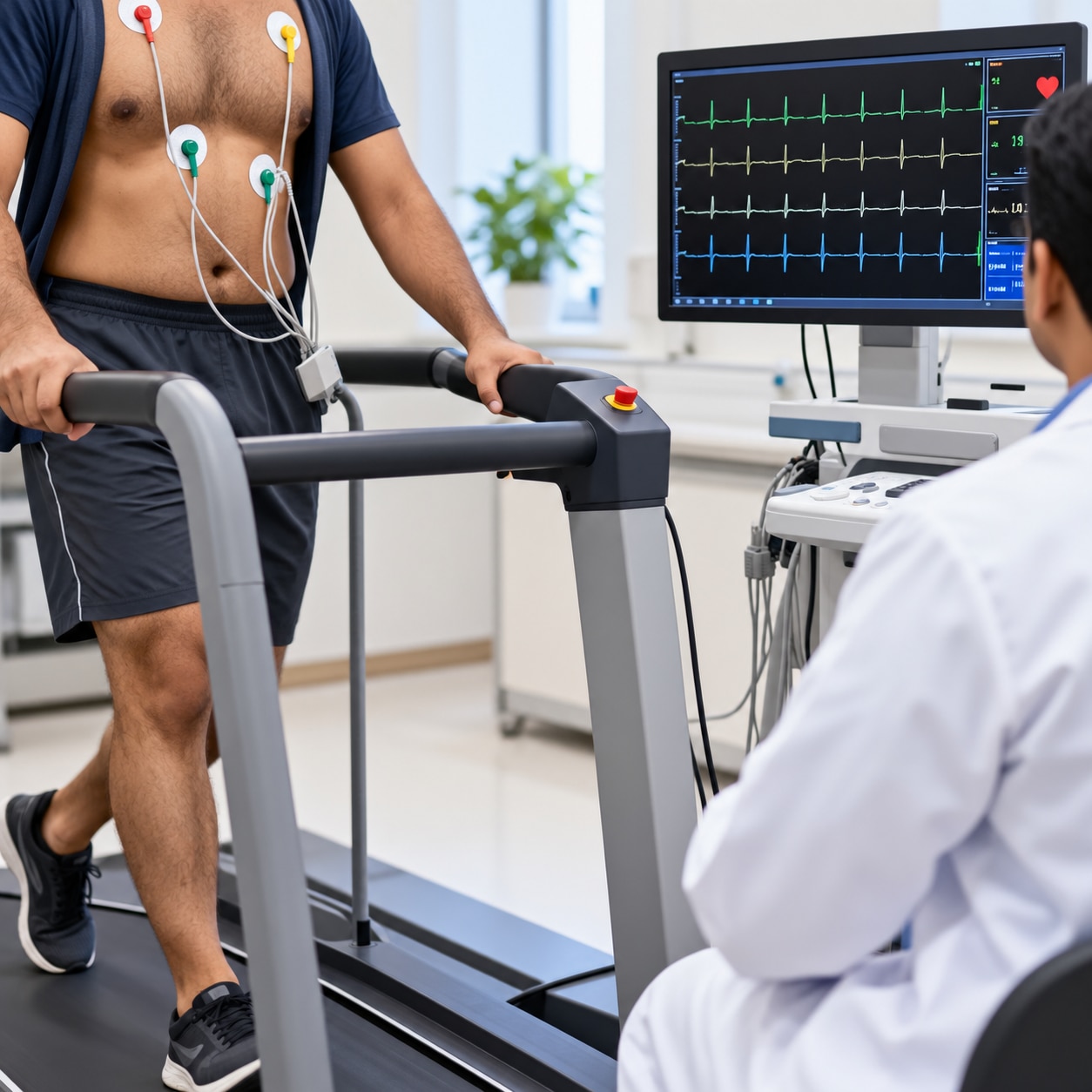
| Before exercise | The team reviews your symptoms, medical history and medicines, records a resting ECG before TMT, checks resting blood pressure and applies adhesive chest electrodes for stress test monitoring. |
| During exercise | You walk while speed and incline rise in stages. The team tracks heart rate, rhythm, blood pressure, ECG changes and symptoms continuously. |
| Recovery | Walking stops, but monitoring continues because abnormal rhythms, blood-pressure changes and symptoms can appear after exercise. |
Wear walking shoes and loose clothing. Avoid a heavy meal before the appointment, bring your medication list and previous ECG reports, and ask how beta blockers and the treadmill test should be coordinated. Never stop prescribed treatment unless the ordering clinician tells you to.
The treadmill portion ends when you reach the planned workload, ask to stop or cannot continue, or concerning symptoms, significant ECG changes or important blood-pressure changes appear. Report chest pressure, marked breathlessness, faintness, severe dizziness or leg pain immediately.
The effort feels like progressively faster uphill walking, and you may breathe heavily as the workload rises. Recovery is part of the test, not an optional final step.
What Can the Test Reveal—and How Is a Result Interpreted?
A treadmill result is not a pass-or-fail verdict. Clinicians interpret ECG findings alongside your symptoms, achieved workload, heart-rate response, blood-pressure response, rhythm and recovery.
The classic concern is horizontal or downsloping ST-segment depression of at least 1 mm, measured shortly after the J point. An ST-segment depression stress test finding has meaning only in context: baseline ECG features, medications and workload can change its significance. A normal resting ECG does not prevent exercise ECG changes from appearing.
The assessment can identify:
- Reduced METs exercise capacity, including early stopping because of fatigue, breathlessness or chest discomfort
- An inadequate heart-rate response or an abnormal rise or fall in blood pressure
- Exercise-triggered supraventricular or ventricular arrhythmias
- Symptoms that occur with exertion, even when the ECG has no diagnostic ST change
- Abnormal recovery, including persistent symptoms, rhythm disturbance or delayed heart-rate reduction
The normal treadmill stress test meaning is narrower than many people expect. It does not exclude intermittent arrhythmia, valve disease, anaemia, lung disease, musculoskeletal pain, non-obstructive or microvascular coronary disease, vasospasm, or coronary disease that produces no detectable exercise ECG change.
Exercise ECG has moderate diagnostic accuracy in commonly cited studies: about 68% sensitivity and 77% specificity. A positive result is not proof of a major blockage, while a negative result is not an absolute guarantee. Persistent or unexplained symptoms require clinical reassessment rather than automatic repetition of the same test.
When Is Another Test More Informative Than a Plain TMT?
A plain TMT is less useful when the resting ECG already makes exercise-related ST changes hard to interpret. Left bundle-branch block, ventricular pacing, significant baseline ST depression, left-ventricular hypertrophy with strain, pre-excitation and digoxin-related changes can all produce misleading or obscured results.
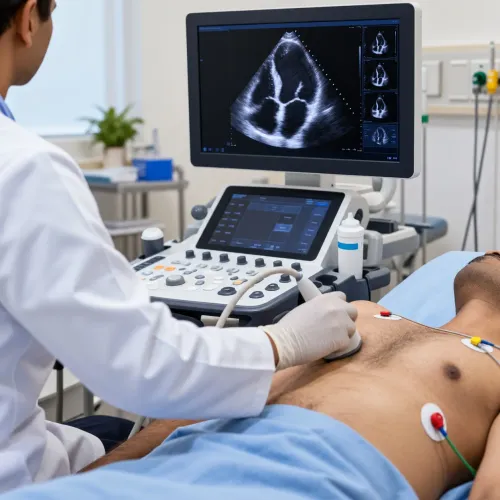
- Use a Holter monitor for intermittent palpitations or dizziness that occur randomly and may not appear during a brief treadmill session.
- Choose a 2D echo for valve disease, chamber enlargement, reduced pumping function or another structural concern.
- Consider stress echocardiography, nuclear perfusion imaging or stress cardiac MRI when you need to see how heart muscle and blood flow respond, especially when the ECG is difficult to interpret.
- Discuss coronary CT angiography after stress test results remain inconclusive, symptoms persist, or coronary narrowing still needs anatomical assessment.
The choice between TMT versus stress echocardiography depends on your ability to exercise, the resting ECG, kidney function, radiation considerations and local expertise. If you cannot reach an adequate workload, pharmacological stress with echocardiography, nuclear imaging or cardiac MRI may be more informative; medication is not simply a substitute for treadmill monitoring.
A false-positive or inconclusive TMT can lead to additional testing. A normal result also does not exclude intermittent rhythm problems, microvascular disease, vasospasm, anaemia or lung disease. Persistent symptoms require reassessment rather than automatic repetition of the same test.
How Do You Arrange the Test and Discuss the Result?
Start by confirming whether the centre requires a TMT referral and preparation instructions. Ask why an exercise ECG fits your symptoms instead of assuming a treadmill test is the best next step. For a cardiology consultation in Pune, bring the following:
- Previous ECGs, echocardiogram reports, blood tests and hospital discharge papers.
- Names and doses of every medicine, especially beta blockers and other rate-slowing drugs.
- Relevant history, including earlier heart disease, fainting, rhythm problems, diabetes and high blood pressure.
- Questions about meals, caffeine, clothing, walking shoes and whether to take prescribed medicines. Never stop a beta blocker without the ordering clinician’s instruction.
Allow time for preparation, electrode placement, resting checks, treadmill exercise and recovery. The walking phase is only part of the appointment. The supervising team can stop the study if symptoms, ECG changes, an abnormal blood-pressure response, marked breathlessness or an arrhythmia appears, then monitor recovery and decide whether further evaluation is needed.
A stress test results discussion should connect your usual symptoms with the ECG, workload achieved in METs, blood-pressure response, rhythm and recovery—not label the test simply “normal” or “abnormal.” Beta blockers can limit target heart rate and alter heart-rate recovery, so the clinician must interpret those measurements in context.
The Heart Clinic - Dr. Satyajeet - 08048066834 can discuss whether a TMT or another cardiac assessment better matches your symptom pattern.
Related service
TMT (Stress Test) TMT (Stress Test) in Aundh, Baner, Pune TMT is the abbreviation for Treadmill Test. The TMT Testing takes into account, the measurement of the blood circulation inside the body (blood... View service → |
Frequently asked questions
Which exercise-related symptoms can a treadmill stress test investigate?
It can investigate chest pressure, breathlessness, unusual fatigue, dizziness, reduced stamina and palpitations that occur during exertion and improve with rest.
What happens during a treadmill stress test?
Clinicians record your baseline ECG and blood pressure, attach monitoring electrodes, then increase treadmill speed or incline while checking symptoms, rhythm, blood pressure and ECG changes. They continue monitoring during recovery.
What can a treadmill stress test reveal?
The test can show how your heart responds to exertion, including exercise-related symptoms, rhythm problems, abnormal blood-pressure responses, reduced exercise capacity and ECG changes that may suggest inadequate blood flow.
When is another test more informative than a plain TMT?
Stress echocardiography, nuclear stress imaging, CT coronary angiography or another investigation may be more useful when the ECG is difficult to interpret, exercise is limited, or the plain test cannot answer the clinical question.
How should you discuss a treadmill stress test result?
Ask the clinician what happened to your symptoms, ECG, heart rhythm, blood pressure and exercise capacity, then discuss whether you need follow-up, treatment or another test.